In 2025, China's energy storage industry bid farewell to "barbaric growth" and entered a stage of "high-quality development." In terms of policy, Document No. 136 canceled the mandatory allocation of energy storage, and Document No. 394 clarified the full coverage of the electricity spot market. "Surviving on real returns" has become the industry rule, and active balancing technology is the core adaptive solution.
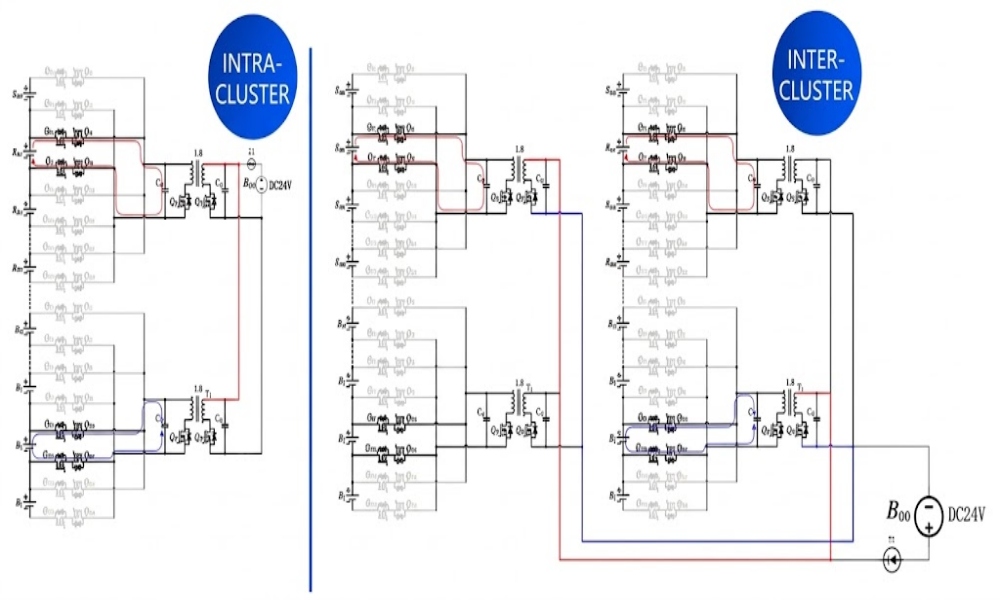 < Gold Electronic "Point-to-Point" Active Balancing Solution >
01
Performance Evaluation: The Core Correlation of System Lifespan
When the energy storage system exhibits the following performance characteristics, revenue risks need to be mitigated in advance:
- Capacity Degradation: When the actual capacity of the battery pack degrades to 70%-75% of the initial capacity (lower than the industry's common 80% "usable threshold"), the endurance will fail to meet basic charge/discharge needs, directly leading to shrinking returns.
- Drop in Charge/Discharge Efficiency: When the charge/discharge efficiency drops below 85%, energy waste intensifies, making it difficult to reverse the downward trend of overall energy conversion efficiency.
- Insufficient Remaining Cycle Life: When the remaining cycle life is less than 500 cycles, or the service life reaches more than 80% of the design life, the risk of system failure rises significantly, and O&M costs will increase accordingly, further squeezing the profit margin.
- Cell Inconsistency: A difference of over 5% will aggravate local cell overcharging and overdischarging, accelerating the degradation of the entire pack. Failure to intervene promptly will lead to millions of yuan in additional equipment costs.
02
Active Balancing: Cracking the Lifespan Risk of Energy Storage Systems
The core of active balancing technology lies in real-time monitoring of cell status and using energy transfer to supplement low-potential cells with energy from high-potential cells. Achieving "precise energy regulation" is the key solution to addressing lifespan risks. Specifically, this technology can resolve four major lifespan risks:
- Addressing cell inconsistency, it can correct differences in real-time, effectively inhibiting the further aggravation of local overcharge and overdischarge phenomena;
- Targeting capacity degradation, it reduces active material loss and slows down the system's capacity degradation rate;
- Responding to the drop in charge/discharge efficiency, it allows cells to charge and discharge synchronously, reducing energy waste and stabilizing overall efficiency;
- Tackling insufficient lifespan, it optimizes charge/discharge conditions, minimizes cell damage, and extends cycle life.
These effects can delay equipment replacement cycles, increase operating income, and save costs, providing technical support for revenue guarantees in subsequent actual projects.
03
Project Case: Practical Verification of Active Balancing Project
(I) Basic Project Configuration
- Project Name: Gansu Minle 40MW/80MWh Energy Storage Project
- Cell Specification: 280Ah LFP
- Battery Pack Architecture: 1P 69S 28T
- Number of Packs: 6 Packs/cluster, 8 clusters in total
- Balancing Tech Application: The entire container is equipped with an active balancing system
- Commissioning Time: December 2022
To quantitatively analyze the specific impact of the active balancing function on the performance of a single battery cluster and the entire cabin battery stack, and to clarify the performance degradation rules of the battery system and its impact on overall operation under the "cabin balancing off" scenario, this comparative experiment was designed.
(II) Project Testing Background
The experiment selected two battery cabins (Cabin 15-2 and Cabin 19-1) in the station. By setting the active balancing function status differently and combining it with the system's original charge/discharge conditions, tests were conducted. The function setting schemes for each cabin are as follows:
- Cabin 15-2: The active balancing function of all battery clusters was turned off to simulate the extreme scenario of "no active balancing in the entire cabin";
- Cabin 19-1: The active balancing function of all battery clusters was turned on normally, serving as the experimental control group to comparatively analyze the baseline performance of the battery system when the balancing function is on;
- The entire station system maintained its original operating conditions and underwent normal charge/discharge cycles to ensure that the experimental environment matched actual operating scenarios, guaranteeing the reference value of the data.
(III) Project Testing Data
Comparison of Average Charging Capacity within Clusters
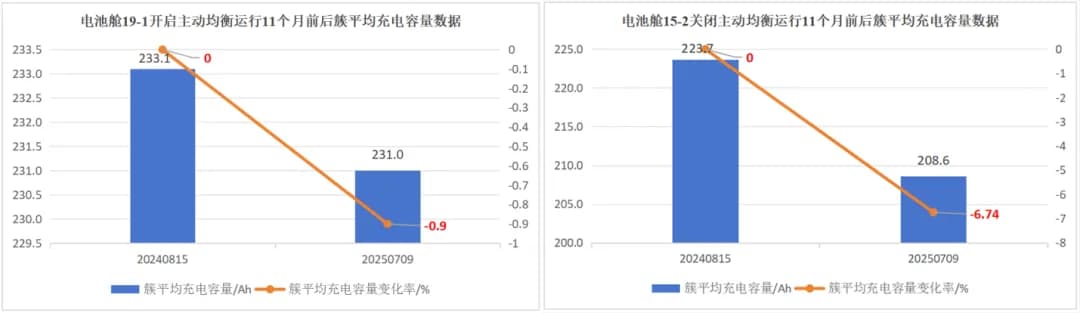
- After 11 months of normal operation with active balancing ON, the average charging capacity of the clusters in Cabin 19-1 was 231.0Ah. Compared with 233.1Ah in August 2024, it decreased by 2.1Ah, a decline rate of about 0.90%;
- After 11 months of normal operation with active balancing OFF, the average charging capacity of the clusters in Cabin 15-2 was 208.6Ah. Compared with 223.7Ah in August 2024, it decreased by 15.1Ah, a decline rate of about 6.74%.
Comparison of Stack Charging Electricity
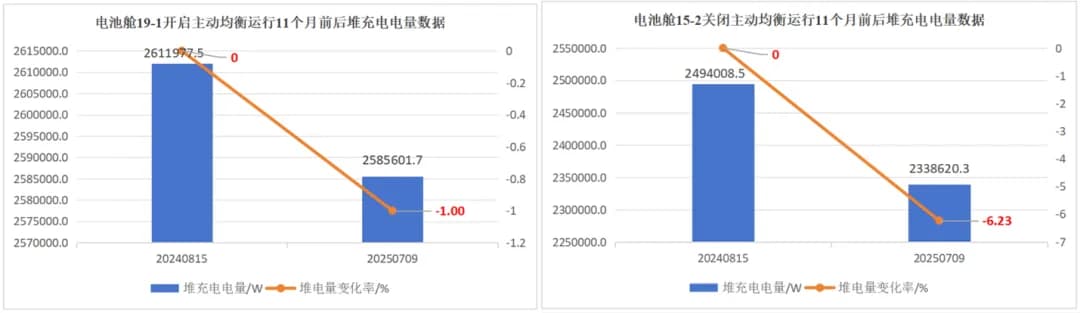
- After 11 months of normal operation with active balancing ON, the stack charging electricity of Cabin 19-1 decreased from the original 2611.977kWh to 2585.601kWh, a decrease of 26.376kWh (about 1.00%);
- After 11 months of normal operation with active balancing OFF, the stack charging electricity of Cabin 15-2 decreased from the original 2494.008kWh to 2338.620kWh, a decrease of 155.388kWh (about 6.23%).
Comparison of Stack Discharging End Max Voltage Difference
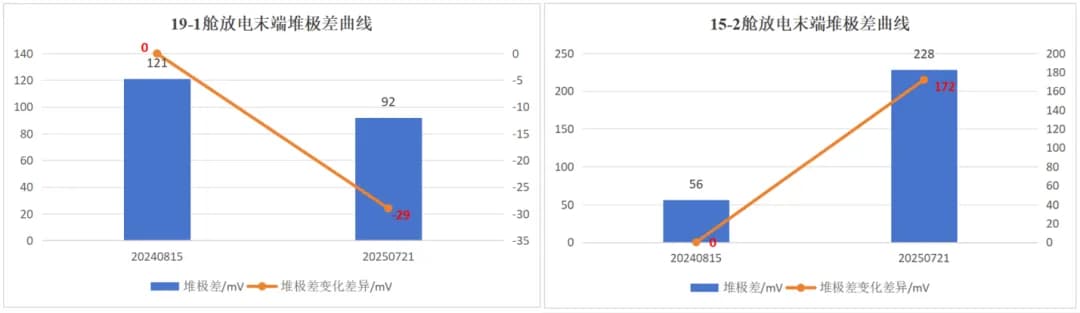
- After 11 months of normal operation with active balancing ON, the stack discharging end max voltage difference of Cabin 19-1 narrowed from the original 121mV to 92mV, a reduction of 29mV;
- After 11 months of normal operation with active balancing OFF, the stack discharging end max voltage difference of Cabin 15-2 widened from the original 56mV to 228mV, an increase of 172mV.
Consistency Comparison
Active Balancing ON (Cabin 19-1)
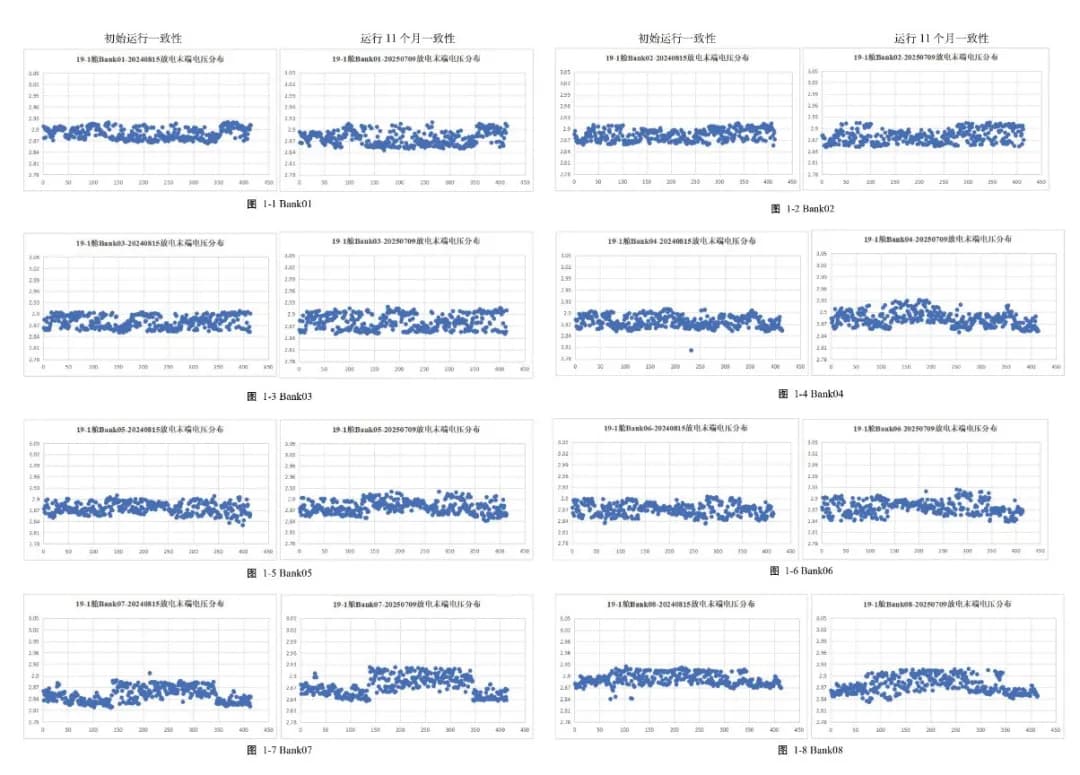
Analysis shows: After 11 months of normal operation with active balancing on, the battery consistency in Cabin 19-1 remained well-maintained.
Active Balancing OFF (Cabin 15-2)
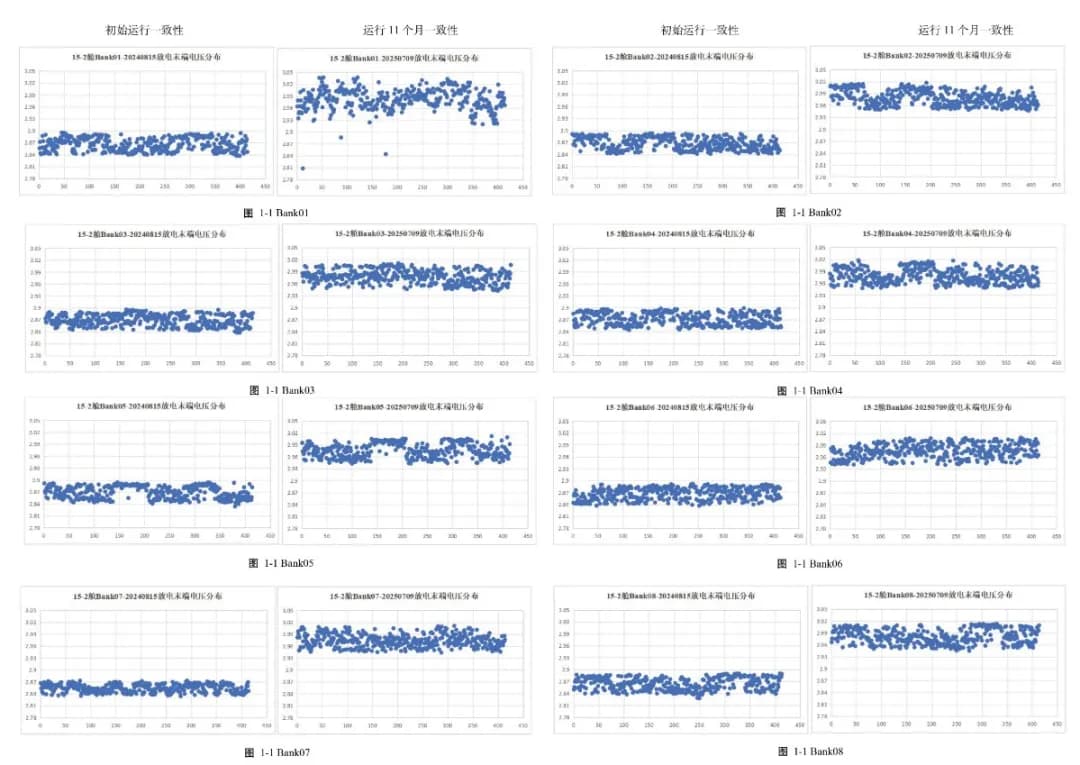
Analysis shows: After 11 months of normal operation with active balancing off, battery consistency differences gradually emerged in Cabin 15-2.
(IV) Project Summary
Summary of Comparative Analysis:
- After 11 months of operation, Cabin 19-1 (Balancing ON) saw its average cluster charging capacity drop by only 0.90% and stack charging electricity drop by 1.00%, while its discharging end max voltage difference narrowed by 29mV.
- Conversely, Cabin 15-2 (Balancing OFF) experienced a 6.74% drop in average cluster charging capacity, a 6.23% drop in stack charging electricity (a loss of 155.388kWh), and its discharging end max voltage difference widened by 172mV.
- The battery cabin with the active balancing function turned on maintained good battery consistency and overall charge/discharge electricity; in contrast, the cabin with the active balancing function turned off gradually developed consistency differences, significantly impacting the overall revenue of the system. Furthermore, in a full charge and discharge cycle, the cabin with active balancing turned on could charge and discharge about 13Ah more capacity than the one without it, a capacity increase of about 6%.
With the advancement of full coverage in the electricity spot market, the demand for "stable performance" and "long-term returns" in energy storage projects will become increasingly urgent.
In the future, whether it's the technology selection for new energy storage power stations or the performance upgrade of existing ones, the advantages of active balancing technology in cell consistency management and full-lifecycle cost optimization will continue to help projects overcome the dual challenges of "lifespan degradation" and "shrinking returns." Amid the wave of high-quality industry development, it will build a solid core competitiveness for more energy storage projects.